
Emergency Tree Service Denver, CO — 24/7 Storm Response
Tree falls on your roof, a limb is hanging over your car, or a storm just snapped your cottonwood — call Tree Service Denver LLC now. We dispatch 24/7 across the Denver Metro with ISA member arborists and the equipment to resolve any tree emergency safely.
What Counts as a Tree Emergency?
A tree emergency is any situation where waiting increases danger or damage: a tree or limb on a house, vehicle, or power service; a trunk cracked, split, or newly leaning after a storm; a large hanging limb (“widow-maker”) over an area people use; or an uprooted tree resting against another. Tree Service Denver LLC answers emergency calls 24/7 across the Denver metro at (720) 807-2785, with same-day response, insurance-ready documentation, and ISA-member judgment about what must happen tonight versus what can safely wait for daylight.
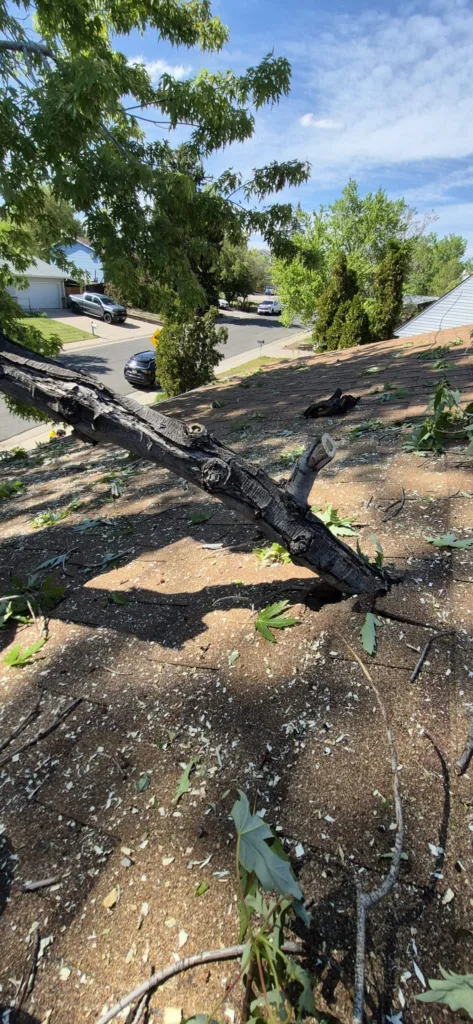
Tree Emergency in Denver? Here’s What To Do Right Now
Call Tree Service Denver LLC at (720) 807-2785 — we answer 24/7. Move people and pets away from the area. If any part of the tree contacts power lines, also call Xcel Energy at 1-800-895-1999. Do not go under hanging limbs or an uprooted tree. Our ISA-member crew will assess the situation, perform controlled removal to protect your property, and provide full insurance documentation.
Emergency Tree Situations We Respond To
If any of these apply — call immediately. Don’t wait until morning.
🌩 Storm-Fallen Trees
Tree fell on your roof, driveway, fence, or vehicle. We dispatch immediately, cut in controlled sections, and secure your property.
⚡ Hanging Limbs
Large limbs suspended overhead after a storm are a silent danger. Wind or a second storm can drop them without warning.
🏠 Lean Toward Structures
A tree that suddenly shifted its lean toward your home, garage, or power line is an urgent structural risk needing same-day assessment.
⚡ Utility Line Contact
If a tree or limb is touching power lines, call us and Xcel Energy. Do not attempt to handle this yourself.
🗻 Uprooted Trees
A partially uprooted tree can shift further at any time. We stabilize or remove it before secondary collapse occurs.
🌳 Post-Storm Assessment
After any major wind or snow event, we assess for hidden structural damage that may not be immediately visible but poses ongoing risk.
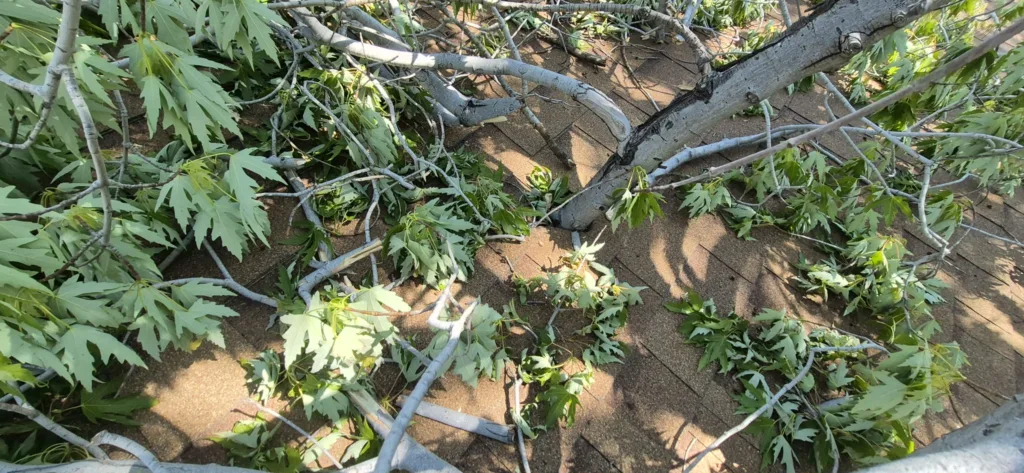
What Happens When You Call
We evaluate the situation over the phone and dispatch the right crew. Response time is typically 1–4 hours depending on storm volume.
Our crew assesses lean angle, root plate stability, contact with structures, and secondary risks before any cutting begins.
We use rigging, ropes, and sectional cuts to bring down the tree or limb safely — protecting your roof, vehicles, and landscaping.
All debris removed. We provide written damage documentation and photos to support your insurance claim if needed.
Does Insurance Cover Emergency Tree Removal?
✅ Typically Covered
Tree falls on your home, detached garage, fence, or vehicle during a storm — usually covered under your dwelling or other structures clause.
❌ Often Not Covered
Tree falls in your yard without hitting a structure. Removal of a dead tree that fell due to neglect rather than a storm event may be denied.
📋 We Help With Claims
We provide detailed written documentation, photos, and removal records your insurance adjuster needs. We work directly with your claims process.
Frequently Asked Questions
How fast can you respond to a tree emergency in Denver?
We offer 24/7 emergency dispatch across the Denver Metro. Response time is typically 1–4 hours depending on crew availability and storm volume. Active roof damage situations are prioritized immediately.
What qualifies as an emergency tree situation?
Any tree or limb that has fallen on a structure, is threatening a structure, is hanging overhead after storm damage, or has contacted utility lines qualifies as an emergency. Call immediately — don’t wait until morning.
Will insurance cover emergency tree removal?
Most homeowner’s policies cover emergency removal when the tree causes damage to a covered structure during a storm. We provide full written documentation to support your claim.
Can you assess storm damage to trees that didn’t fall?
Yes. We conduct post-storm assessments to identify hidden structural damage — split crotches, root zone movement, hanging wood — that may not be immediately visible but poses ongoing risk.
What do I do if a tree is touching power lines?
Call Xcel Energy at 1-800-895-1999 and then call us at (720) 807-2785. We coordinate with the utility to safely resolve the situation. Do not attempt to handle power line contact yourself under any circumstances.
The First 30 Minutes: What to Do Before We Arrive
Keep everyone away from the tree — including from the side that looks fine; loaded wood stores spring energy and fails in unpredictable directions. If anything is touching a power line or the service drop to your house, treat the entire area as energized, stay clear, and call Xcel before anything else — no tree crew works energized lines. If the tree is on the house, get people out from under the affected rooms; if it’s on a car, leave the car. Photograph everything from a safe distance for insurance. Don’t start cutting — homeowner chainsaw work on storm-loaded trees is how every spring’s worst injuries happen, and a partial cut can make our stabilization job more dangerous. Then call us: we’ll triage by phone, tell you honestly whether it’s a tonight problem or a tomorrow problem, and dispatch accordingly.
One more calm-weather task worth two minutes: walk your property after reading this and note which trees overhang what — knowing your own map before a storm turns a panicked 3 a.m. description into a precise one, and precision is dispatch speed.
Storm Damage and Insurance: How the Claim Actually Works
Homeowners policies generally cover tree removal off a covered structure — the tree on your roof, garage, or fence — plus the resulting repairs, while a tree that falls harmlessly in the yard is usually your own cleanup. Two things make claims go smoothly: documentation and sequence. Photograph everything before any cutting; our crews document again on arrival, and our invoices itemize the emergency work (stabilization, removal off structure, debris) the way adjusters need to see it. If a neighbor’s tree hit your house, your policy typically responds first regardless of whose trunk it was — liability shifts only when prior negligence can be shown, which is where a documented pre-loss hazard (or our post-loss causation findings) matters. We can’t promise what any policy pays, but we can make sure nothing about the paperwork is the reason a valid claim struggles.
Emergency Response at a Glance
- Line: (720) 807-2785 — answered 24/7/365
- Response: Same-day metro-wide; phone triage tells you tonight vs. tomorrow
- Power lines: Xcel first, always — nobody works energized trees
- Insurance: Photo documentation and adjuster-ready itemized invoices
- After: Stabilization, removal, and a storm check of what’s still standing
Save the number now, before the storm that needs it — the calm version of you makes better decisions than the 2 a.m. version, and both get the same crew.
And because it bears repeating in every storm season: no yard cleanup is worth a life. Loaded trunks, tensioned limbs, and anything near a line are professional problems by definition — the emergency exists to be handed to people equipped for it. Make the call, keep your people clear, and let the part of this that’s dangerous be our part.
Tree Emergency? Call Now — We Answer 24/7
Don’t wait. Every minute a compromised tree hangs over your home is a liability. ISA member arborists on call around the clock across the Denver Metro.
ISA-Member • $1M Insured • Zero-Damage Guarantee • Same-Day Response