
How We Work — Simple, Transparent, No Surprises
Tree Service Denver LLC follows the same four-step process on every job — from a single stump to a full lot clearing. Free estimate, written proposal, professional execution, complete cleanup. No verbal quotes, no mid-job surprises, no debris left behind.
What Is Our Tree Service Process?
Our process is a six-step system that takes every Denver tree job from first call to final walkthrough: a free on-site assessment by an ISA member arborist, a written itemized estimate, scheduling around your calendar, a documented safety plan, careful execution to ANSI A300 and Z133 standards, and a complete cleanup with a final walkthrough. The same process applies whether we’re pruning one maple or clearing a commercial lot — it’s how Tree Service Denver LLC guarantees zero property damage and no surprise charges.
4 Steps from Call to Cleanup
Call or text (720) 807-2785 any time. Eric Petruska answers personally — not an answering service, not a dispatcher. Describe your situation: what you need, your address, and any urgency. Emergency calls are dispatched immediately, 24/7. Standard jobs get a same-day estimate appointment scheduled.
Eric visits your property and assesses every tree in question. He evaluates species, health, structural risk, access constraints, proximity to structures, and the right technical approach. If a tree doesn’t need to come down — or if a simpler solution like cabling or pruning is appropriate — Eric will tell you that. Honest assessment is non-negotiable at Tree Service Denver LLC.
You receive a written estimate documenting the exact scope of work, what’s included (debris removal, stump grinding if applicable, cleanup), and the final price. Tree Service Denver LLC never provides verbal quotes. The written estimate is the price — no mid-job additions without your explicit written approval. Take your time, compare estimates, decide when you’re ready.
ISA-member crew arrives on schedule with proper equipment — aerial lift or rope-and-saddle depending on access, chipper, and haul truck. All work follows ANSI A300 standards. Zero-damage rigging on every removal near structures. When the job is done, every piece of debris is chipped or hauled away, chips blown off surfaces, and the site is left cleaner than we found it. No piles left. No cleanup left for you.
What We Never Do
These are non-negotiables on every Tree Service Denver LLC job.
❌ We Never Top Trees
Topping destroys tree structure, creates decay entry points, and causes rapid regrowth of weakly attached branches. It is explicitly prohibited under ANSI A300. We refuse topping requests — and explain why.
❌ No Verbal Quotes
Every estimate is written. Verbal quotes create misunderstandings and disputes. If a tree company won’t put it in writing, walk away.
❌ No Uninsured Crews
Every crew member on every job is covered by workers’ compensation insurance. COI available before work begins. We never send uninsured workers onto a client’s property.
❌ No Debris Left Behind
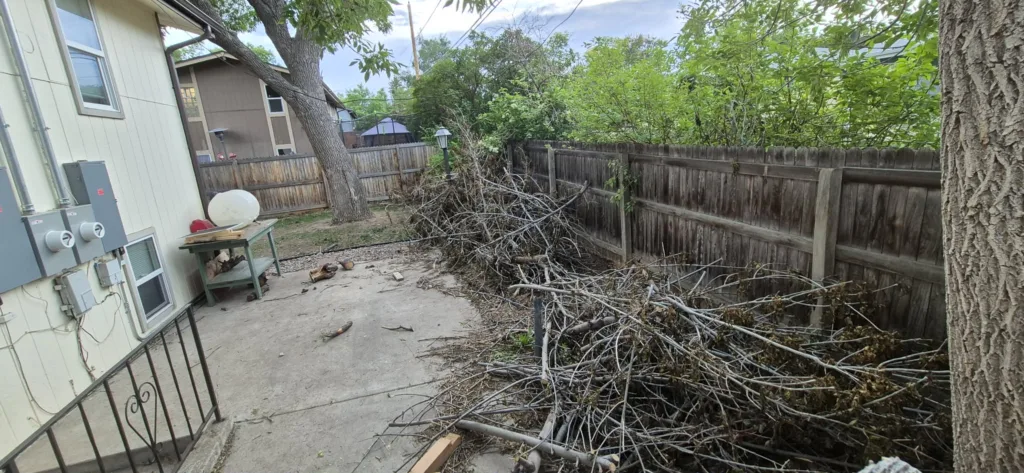
All material is chipped or hauled away on the same day as the job. We do not leave brush piles, log sections, or chips on your property without explicit agreement.
Step Deep-Dive: The Arborist Assessment
Most tree companies send an estimator whose job is to sell. We send an ISA member arborist whose job is to diagnose. During the assessment we evaluate the tree’s species, structure, lean, root condition, decay indicators, and proximity to structures, utilities, and neighboring property. We check for Colorado-specific stressors — drought cracking, sunscald, hail wounds, and pests like emerald ash borer. Then we tell you the truth: sometimes that means a tree you thought was doomed can be saved with cabling or health treatment, and sometimes it means a tree you love has become a genuine hazard. The assessment and the written estimate are always free.
The Safety Plan Behind Every Job
Before a saw starts, the crew walks the site and documents the rigging plan: where limbs will be lowered, what gets protected with mats or plywood, where the drop zone is, and who controls it. We work to ANSI Z133 — the arboriculture safety standard — with roped and harnessed climbers, ground spotters, and controlled lowering for anything over a structure, fence, or garden. This is the difference between professional tree work and a chainsaw with a ladder, and it’s why we can back every job with a zero-damage guarantee and $1M in liability coverage.
Cleanup, Walkthrough & What Happens After
Every job ends the same way: limbs chipped, wood hauled or bucked to your preference (or delivered as firewood), rake-out of twigs and sawdust, and a final walkthrough with you. If we removed a tree, we’ll quote stump grinding so nothing is left to trip over or re-sprout. And we leave you with straightforward care advice for the trees that remain — when to prune next, what to water, and what warning signs to watch for.
More Questions, Answered
How long does the estimate visit take?
Do I need to be home during the work?
What standards do you follow on every job?
What happens if something is damaged?
Can the process be expedited for emergencies?
Our Process vs. the Industry Default
The industry default: a phone quote or a windshield estimate, a verbal price, a crew that shows up sometime, and a pile of wood chips where your garden was. Every step of our process exists to delete one of those failure modes. Written scope from a ISA member arborist deletes misdiagnosis. The itemized estimate deletes surprise charges. The documented rigging plan deletes property damage. The final walkthrough deletes the “they-left-without-finishing” review that plagues this industry. Process isn’t paperwork — it’s how a 5.0-star average survives 166 reviews and fifteen years.
It also compounds: every documented job makes the next assessment sharper, because fifteen years of Front Range case history — which species failed, in which storms, in which neighborhoods — is a diagnostic database no shortcut operation will ever have. Process is how experience becomes institutional instead of anecdotal.
What a Typical Timeline Looks Like
For a standard residential job: day 0, you call or submit the form and we confirm scope; day 1-3, the free on-site assessment and written estimate; approval whenever you’re ready (quotes hold 30 days); work scheduled typically within 1-2 weeks, seasonally faster; job day, most single-tree work completes in 2-6 hours including cleanup. Emergencies compress all of that to same-day. Larger projects — multi-tree removals, lot clearing, commercial contracts — get a written schedule up front so you know exactly which days crews are on-site. We hit the dates we give, and when Colorado weather intervenes, you hear from us before the appointment, not after.
The Process at a Glance
- Step 1: Free on-site assessment by an ISA member arborist
- Step 2: Written, itemized estimate — valid 30 days
- Step 3: Scheduling around your calendar (same-day for emergencies)
- Step 4: Documented safety & rigging plan before any cut
- Step 5: Execution to ANSI A300/Z133 with property protection
- Step 6: Complete cleanup + final walkthrough with you
Six steps, no exceptions, whether the job is one branch or a full commercial contract — because every shortcut in tree work eventually lands on someone’s roof, lawn, or invoice.
One last point on why the order matters: assessment before estimate means the price reflects reality; plan before saw means the risk is engineered out, not improvised around.
Call Eric — Free Estimate, Same Day
The process starts with one call. Eric answers personally.